1. Why do people who are not "evil" take the first step into evil? What, for instance, is involved in taking that first step "down the primrose path to the everlasting bonfire" (Macbeth, 2.3)? What are the consequences of the individual choosing evil (particularly the internal consequences)? Use examples from the text to support your opinion.
People who are not evil take the first steps toward evil because they have are influenced by others or they have a desire for power. These conditions can be seen by examining Macbeth and his thoughts and actions.
The first steps toward evil for Macbeth for example came after he heard the prophecy of the witches. After hearing them say "All hail, Macbeth, thou salt be king hereafter!" Macbeth realized his potential. He realized that he had the qualities of a leader and that he could obtain more power and influence in society than he had before. He never had considered the idea of being a king before this point and the influence of the witches led him to become obsessed with seeking power. Macbeth was not only influenced by his wife. Lady Macbeth had a large impact on Macbeth's decisions. After thinking about the letter that Macbeth sends to her she says to him "Your hand, your tongue: look like the innocent flower, But be the serpent under't." She says that Macbeth appears to be innocent since he has just eliminate a traitor of King Duncan. She encourages him to act as a serpent or a snake and kill Duncan instead so that Macbeth could take his place as king. She also reassures him and tells him they can't fail, influencing him in his decision - "But screw your courage to the sticking-place, and we'll not fail."
Lady Macbeth's constant influence on her husband as well as Macbeth's new desire for power after meeting the three witches is what is involved in him taking the first step. He tells himself that "If ill, why hath it given me earnest of success, commencing in a truth?" Once he believes that what he is doing is for the best and being influenced by the witches' prophecy, he is willing to take the first step in evil. Macbeth himself recognizes his new ambition when he says "I have no spur to prick the sides of my intent but only vaulting ambition." The floating dagger also influences him as he believes in the power of the supernatural and interprets the dagger as a sign to kill the King. When Macbeth says that the dagger is leading him to the place he was going to, he is even more determined and therefore influenced towards evil.
The consequences of choosing evil are the guilt that comes with doing evil actions, shown when Macbeth kills Duncan and says "I'm afraid even to think about what I've done. I can't stand to look at it again." Macbeth doesn't want to go back and look at the murder because he knows he did evil and feels guilty for murdering his King to who he owed his loyalty. When choosing evil Macbeth also questions his actions and even goes as far as to say "Had I died but an hour before this chance, I had lived a blessed time, for from this instant There's nothing serious in mortality." He feels so guilty and resentful of his own actions that he says there is nothing worth living for anymore. This creates an internal struggle as he has achieved his desire for power but feels guilty and wishes he had not done it.
Sunday, November 22, 2015

Sunday, November 8, 2015
#IBmakingart
http://www.metmuseum.org/toah/works-of-art/63.12
The Cloisters Cross, 12th century
English
Walrus ivory; 22 5/8 x 14 1/4 in. (57.5 x 36.2 cm)
The Cloisters Collection, 1963 (63.12)
The cross is a direct display of the importance of Christianity during this time period. The Cloister Cross has different depictions on each side which have different meanings.
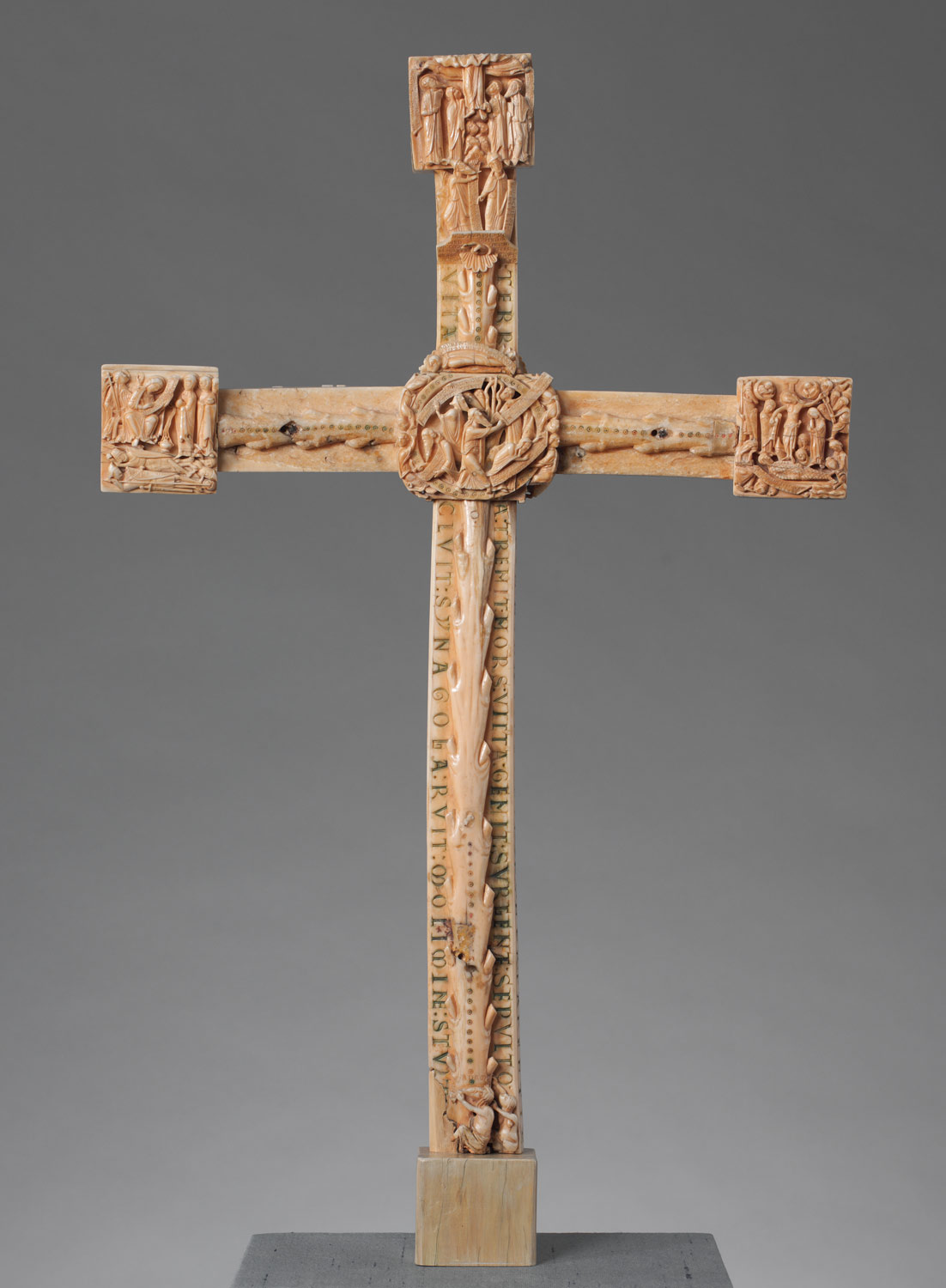
This side of the cross
reads "the earth trembles, death defeated groans with the buried one
rising./ life has been called, synagogue has collapsed with great foolish effort." and
"Cham laughs when he sees the naked private parts of his parent/
the Jews laughed at the pain of God dying." From this it is clear that the
artist was clearly a Christian. Based on the words inscribed into the piece it
seems that Jews were looked down upon. Based on this time period negative views
of Jews by Christians was not uncommon especially in England where the cross
draws its origins from.
In
the picture of this side the top appears to resemble the hilt of a sword
with the long extending bottom being a blade. This appears to be in reference
to all of the wars and fighting that has been going on during this
period.
Each
of the three outer most points has groups of people gathered together. It is as
though these people are looking up toward the sky or perhaps toward heaven.
This appears to be representative of God as the Father. This portion of the
Holy Trinity being the one that resides in heaven watching down on Earth as is
seen frequently throughout the Christian faith. At the right there is a man
with his arms stretched out as though he is on a cross surrounded by many other
people. This portion of the cross depicts the death of Jesus on the cross. The
left portion of the cross difficult to see from this picture, but it seems that
the three outer portions are intended to represent the Holy Trinity.
At
the bottom of the cross are a man and a woman that are holding on to what I interpreted
at the swords blade earlier. This could be another reference to the Bible and
the man and women could be Adam and Eve. The blade of the sword is the tree of
life from which they took fruit when they were told not to by God. The very
tree which they held on to ended up causing them pain just as a sword is the
creation of humans but has only caused pain to other humans.

On this side of the
cross the larger images are more animalistic. Based the book The Cloisters
Cross: Its Art and Meaning By Elizabeth C.
Parker, Charles T. Little the animals are (to the right) the ox of Saint Luke,
(to the left) the Lion of Saint Mark and (at the top) the Eagle of Saint John.
They are perhaps displayed because they are the ones that Christians looked up
to. There is a missing section at the bottom which may have been reserved for
Matthew. The shaft of the cross holds other people who must have been prophets
or disciples as well. In the center of the cross there is a carving of a lamb.
This represents the Lamb of God. The Lamb of God is Jesus and because of this
majority of the figures on this side of the cross are looking toward the
center. The portion of the cross running between the Lion and the Ox appear to hold
even more people looking toward the center of the cross. They are looking
toward Jesus even though he is being slain in they will continue to keep their
eyes on him and follow him. The few figures that do look away must represent those
who betrayed Jesus or will not follow the path that he set for them.
Subscribe to:
Comments (Atom)